
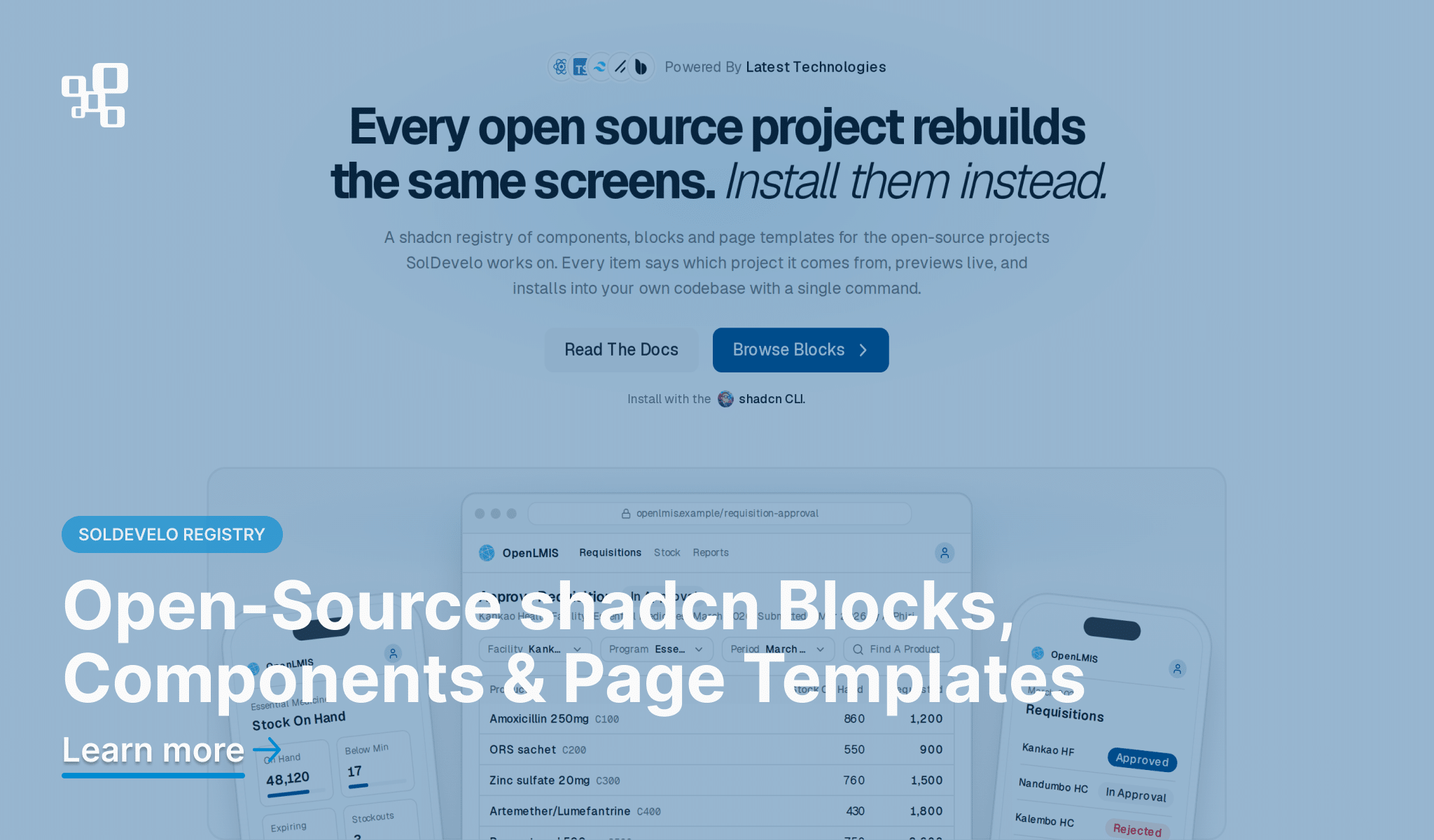
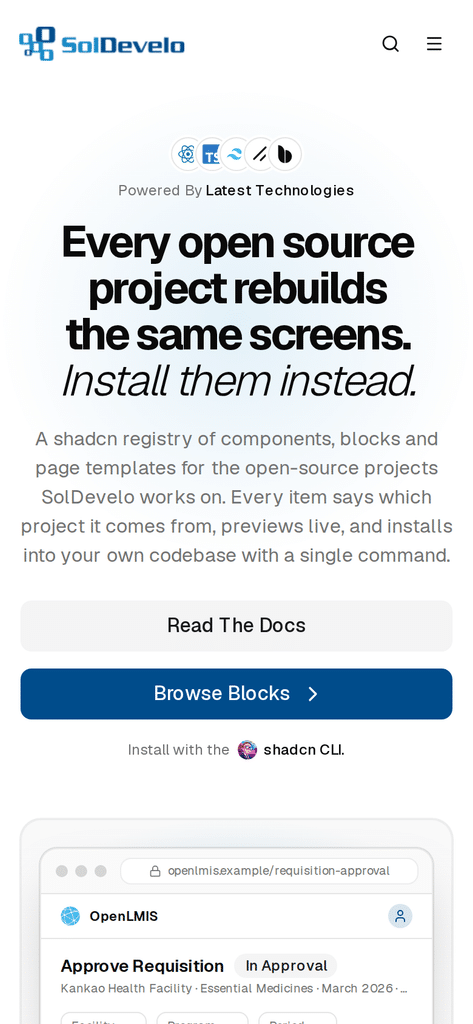
SolDevelo Registry is a free, MIT-licensed collection of open-source shadcn blocks, React components, and page templates built for real-world web applications. Built on shadcn/ui and Base UI, the registry ships with production-tested items extracted from SolDevelo’s open-source projects, starting with OpenLMIS. Every item can be previewed live in the SolDevelo Registry catalog and copied directly into your repository with a single command.
The Challenge:Every Project Rebuilds the Same Screens
Most free shadcn block collections focus on marketing websites – hero sections, pricing tables, and testimonial grids. Engineering teams building operational software face a completely different set of UI problems: server-paginated data tables, multi-filter search toolbars, CRUD dialogs, and role-management screens.
Open-source platforms for health, logistics and public services are often built by small teams on limited budgets. Yet almost every one of them builds the same screens: a table that pages through records from the server, a search box and filters above it, a dialog for adding and editing, a dashboard card that shows what to do while data loads or fails. Then the next project builds them all again.
Those rebuilt versions are rarely equal. One handles empty states and another does not. One works on a phone and another breaks. Quality depends on who built the screen, and when.
Why it matters: every week spent re-creating a data table is a week not spent on what makes a system valuable – its workflows, its integrations and the people who use it in the field. We have seen this across ten years of work on open-source global health software, including OpenLMIS, openIMIS and OpenBoxes, so we decided to build these patterns once, properly, and share them.
What’s Inside: Open-Source shadcn Blocks, Base UI Components & Templates
SolDevelo Registry is a shadcn registry built on shadcn/ui and Base UI. It currently offers 29 items, each with a live preview and its full source, all released under the MIT license.
The shadcn CLI copies the source code directly into the repository, together with the shadcn primitives and npm packages it depends on. There is no wrapper package and no runtime dependency on the Registry, so teams own the code from the first install and can adapt it freely.
The catalog is organized into three layers so teams can take only what they need:
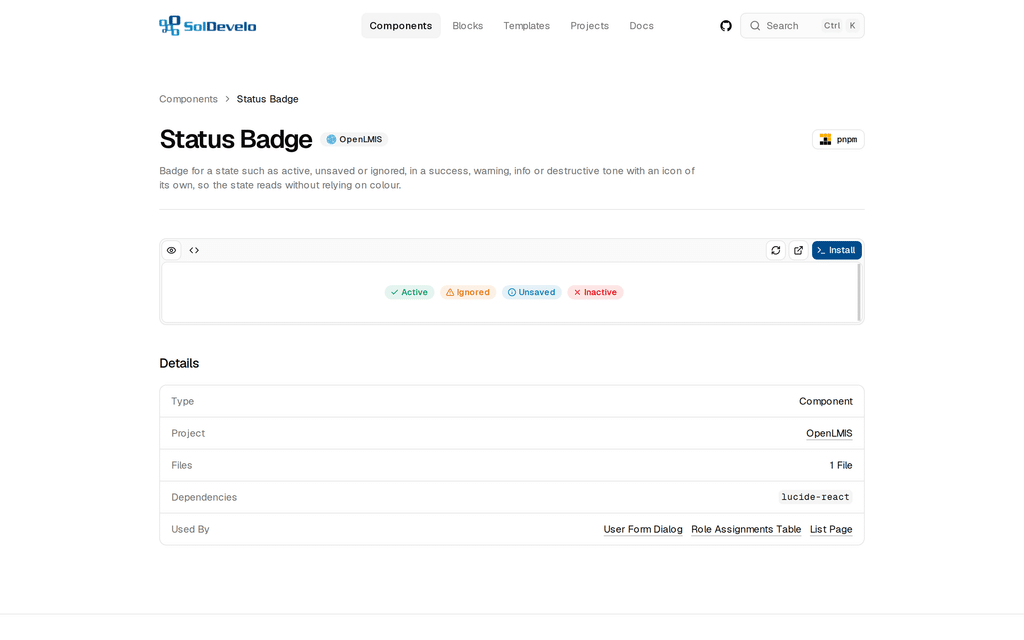
- Components (12): Single pieces that render a value consistently, such as a status badge, a search input, form fields or pagination.
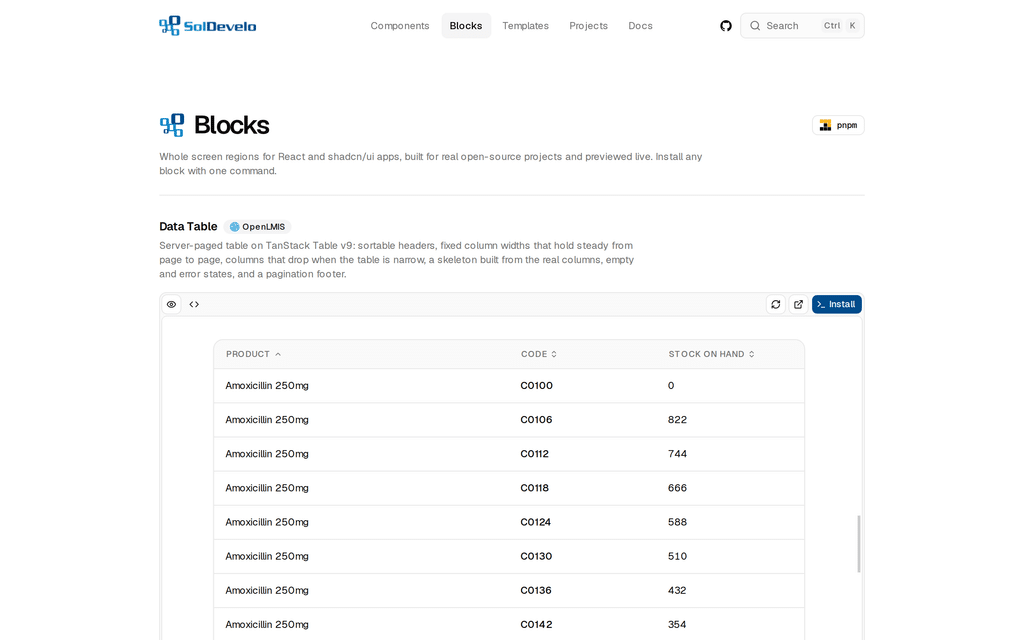
- Blocks (13): Complete screen regions with layout and dark mode handled, such as a server-paged data table, a user form dialog, an add role dialog or a requisitions chart.
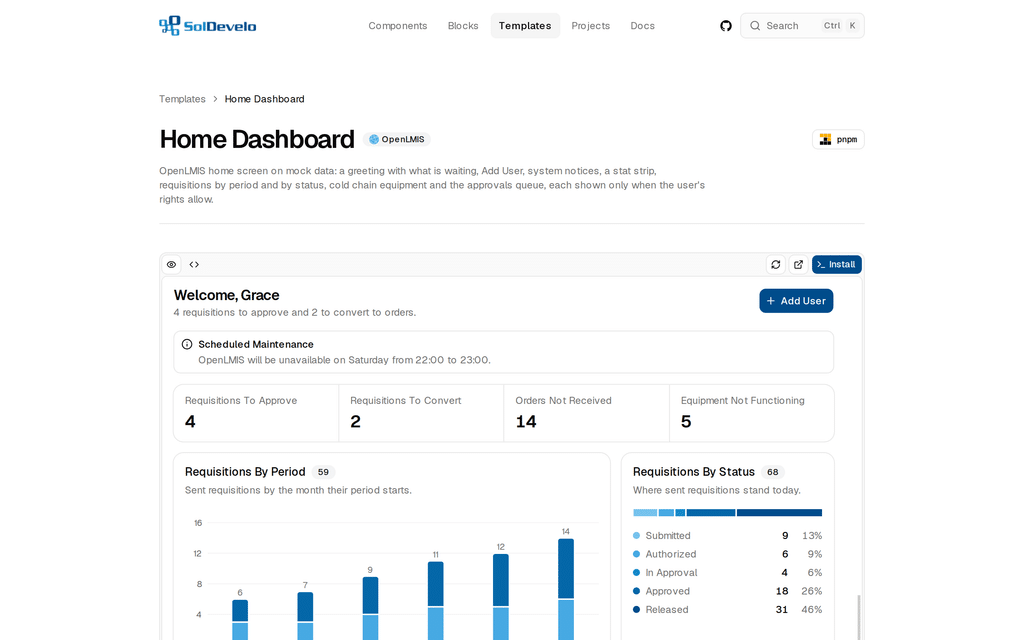
- Templates (4): Full application views with editable copies of every section, such as a home dashboard, a list page or a user roles management page.
How to Install Open-Source shadcn Blocks via the shadcn CLI
Adding items from SolDevelo Registry requires no account, API key, or custom package manager – it uses the standard shadcn CLI workflow.
- Register the namespace once in the project’s components.json:
{

  "registries": {

    "@soldevelo": "https://registry.soldevelo.com/r/{name}.json"

  }

}- Add any item by name:
npx shadcn@latest add @soldevelo/openlmis-data-table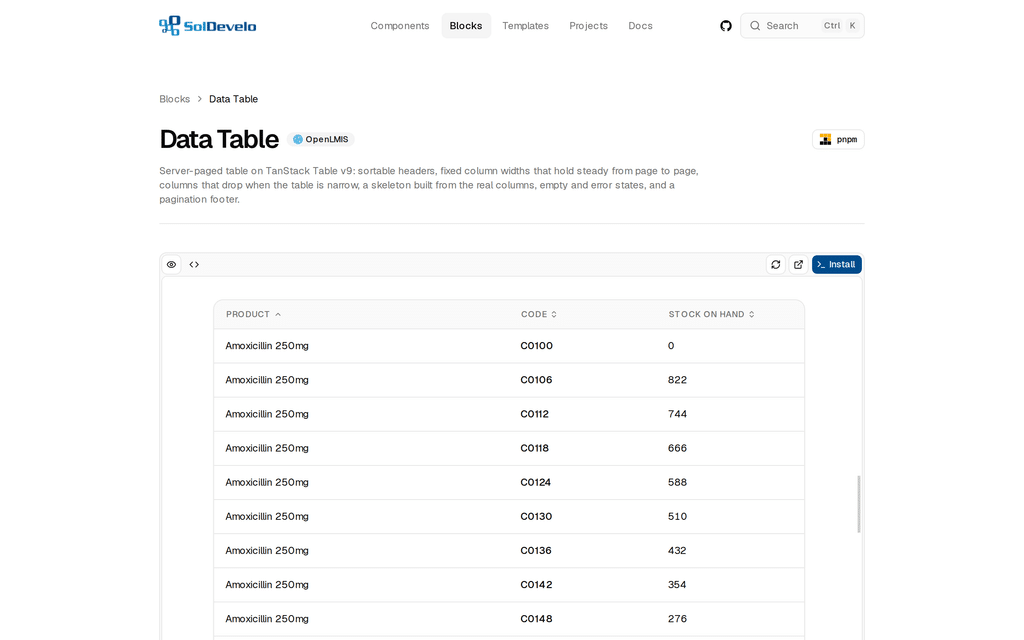
Built from a Real Product – Not a Demo Showcase
None of the items in SolDevelo Registry were designed as isolated showcase demos. They come from the new OpenLMIS user interface that we are building now, and they are written so they can move into the Registry unchanged. Every item states which project it comes from, and each project has its own page in the catalog.
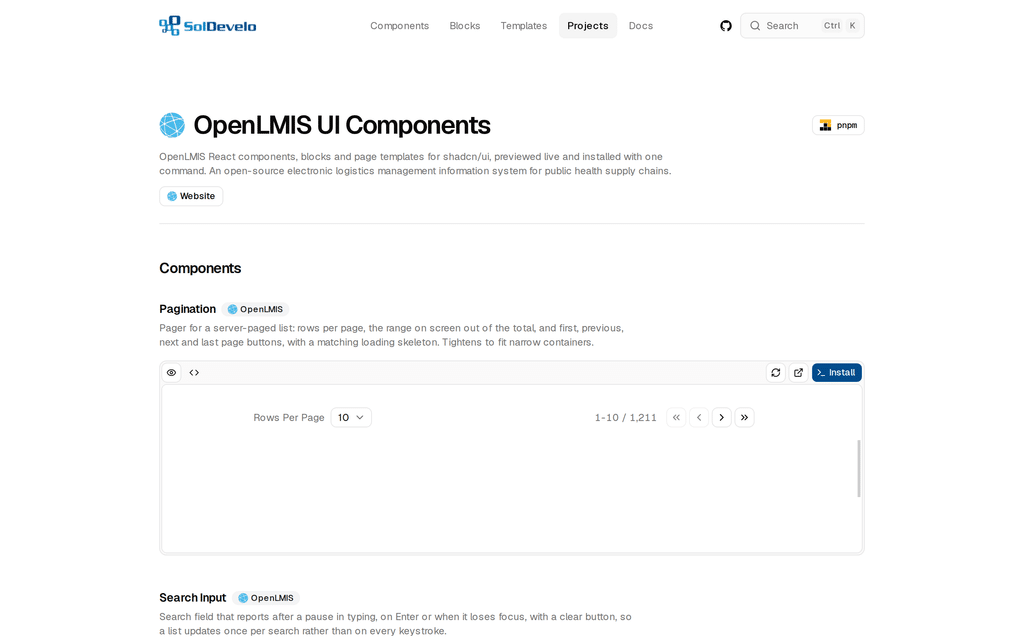
Because they are built for a real application rather than a showcase, the items handle the details that are easy to skip:
- Every state: Loading skeletons in the item’s real shape, empty states, and errors with a way to try again.
- Narrow screens: Table columns drop and toolbars restack instead of overflowing.
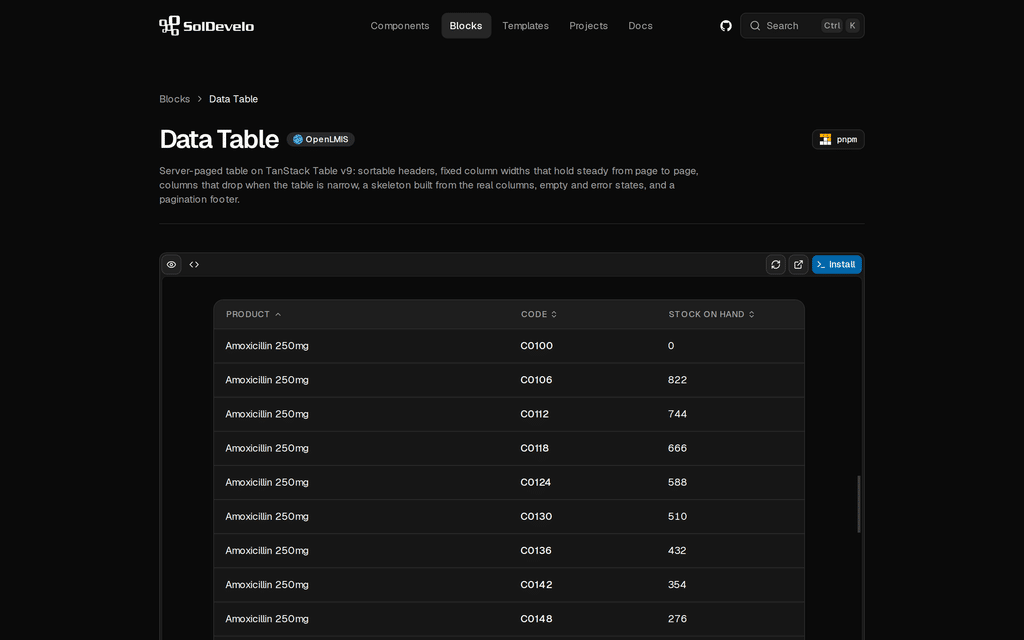
- Dark mode out of the box: Every surface, border, and chart token respects your theme configuration.
- Accessibility in mind: Keyboard support from Base UI, states that do not rely on color alone, and charts with a table for screen readers.
Built for AI-Assisted Development
AI coding agents are fast, but without guardrails they tend to invent a slightly different table, form and dialog each time – and speed without consistency creates tomorrow’s tech debt. As we described when building a production React frontend with AI, AI moves fast when strong engineering foundations are already in place.
SolDevelo Registry is one of those foundations, and it powers our own agentic coding: instead of generating a screen from scratch, an agent installs a tested one and builds on it. The catalog is machine readable as well as browsable:
- llms.txt: Summarizes every component, block, and template in the registry so AI assistants can discover the right building blocks quickly.
- shadcn MCP server: Lets coding agents search and install from the Registry once the namespace is registered:
npx shadcn@latest mcp init --client claudeThe –client option also accepts cursor, vscode and codex.
Commitment to Open Source
SolDevelo Registry grows with our work. As more OpenLMIS screens move to the new UI, their reusable parts will be added to the catalog. The Registry is also multi-project by design: components from other open-source projects we work on can sit alongside OpenLMIS in the same theme, so they work well together.
It reflects how we like to contribute to digital public goods: build it once, build it well, and leave behind something others can use. The Registry is free, requires no account, and welcomes issues and pull requests.
Registry documentation
- Browse the live catalog: registry.soldevelo.com
- Read the setup docs: registry.soldevelo.com/docs
- Contribute on GitHub: github.com/SolDevelo/soldevelo-registry
Looking for an Open-Source Expert?
From modern frontends and design systems your teams and AI tools can share to long-term stewardship of open-source platforms, we can help. Contact our team to learn how we can support your next project.